Good CPD Guide

We’ve been very busy over summer, and are proud to announce our new product, GoodCPDGuide.com, bringing you a fresh approach to finding the right professional development opportunities, and making your training both more effective, and better value.

  • Find the most relevant training courses with ease, for free!
  • Keep up to date with courses that match your interests.
  • Make your CPD more effective – keep in touch with other delegates, share resources, and be reminded of your key learning points.
  • Check reviews of courses before you book, and review your experience after attending.


For CPD providers, our site will be a highly-effective way for you to reach the right teachers and schools.

  • It’s a risk-free way to advertise your courses and services.
  • No up-front fees or registration costs,and just 15% referral fee upon booking courses, or a flat-fee click-through charge to your website for further information.
  • You retain control of payments
  • Reach your target customers – we will carefully match your products to users’ needs.
  • Take control of reviews – you can publish a reply to any review, or reject inappropriate ones.

We’d love to hear from providers who would like to be listed when we launch. We’ll be publishing more information about the launch date very soon. In the meantime, do sign up for more information.

How cool is your cup of tea?

Some holiday Physics fun.

Problem: Two mugs of tea are poured from a boiling urn. One of them contains milk, and the other has the milk added after 5 minutes. Which one ends up cooler after 20 minutes?

Let’s make some basic (and slightly dodgy) assumptions.

  1. Let’s state that the milk reduces the temperature of the tea by exactly 20 degrees C, no matter when added.
  2. Let’s assume that the mug/cup has negligible heat capacity, and that conditions are such that the rate of heat loss is directly proportional to the temperature difference between the tea and the room.
  3. Let’s say the room temperature is 20 degrees C.
  4. Let’s guess that the liquid cools at a rate of 0.95 x temperature difference, every minute.

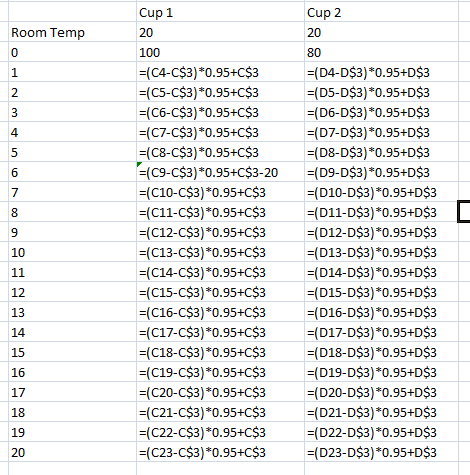
Right, let’s crack out our trusty spreadsheet. Taking my assumptions above it should be set up as:

Formulae for use in Excel

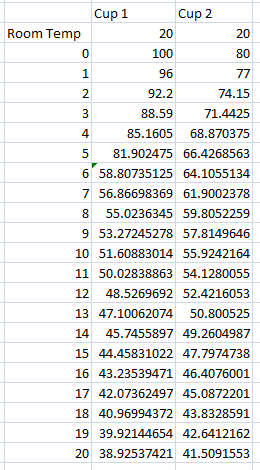
This should produce the following numbers:

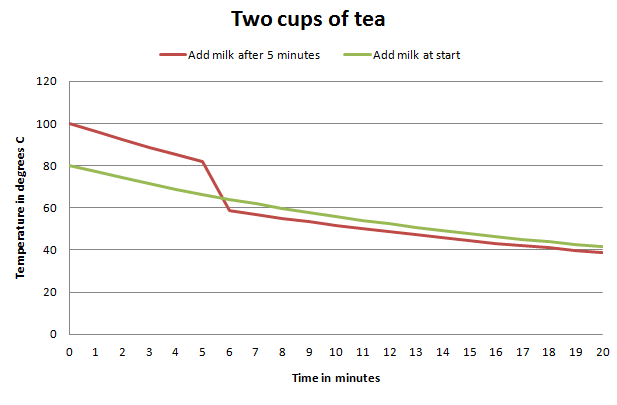
And finally, the fun part, here’s the graph!

So adding after 5 minutes gets you the cooler cup! Leaving the liquid hotter for the first 5 minutes means it loses a greater quantity of heat.

Of course, there are so many other factors affecting this, you might find something a little different in practice. Plus my assumptions about milk’s cooling effect, and the effect of the mug are highly suspect. Anyone care to offer an improvement? Grab a brew and get to work!

Making sense of predictions and targets

These days, schools are awash with targets, estimates, and predicted grades. Used well, they are a way to embed a common ambitious vision for each child. Used badly, they are a demotivating, self-fulfilling prophecy of underperformance.

It’s really important to understand the difference between these:

  • Target: “I would like you to aim for…” – a reasonably ambitious goal that stretches the student.
  • Prediction: “In my judgement you’re currently heading for…” – a professional opinion, based on evidence of assessment.
  • Estimate: “Similar students to you most commonly achieved…” – a statistically-generated grade based on previous exam results and/or developed ability (aka the current IQ score or similar).

It’s really important to be clear about the difference. Start telling a student that you are predicting them a B grade, and some will hear that you don’t think they can achieve an A grade. It’s a veritable mine-field, and one where you can easily push students in to labelling themselves: i.e. “this grade tells me how clever I am”.

Here’s an example of the sort of language you might use with students (in the English education system).

Teacher: “Sarah, most students who got the same levels as you in their Key Stage 2 SATs went on to get a B in GCSE Maths. Some of them worked harder and got an A, and a few of them worked really hard and even got an A*. However, the ones who gave up easily in lessons got lower grades. You and I don’t know how hard you’ll work yet, but we should set a target to aim for.”

Some schools like to use chances graphs to help them explain this information, like the following:

This is a great way of showing students the grades that similar students achieved. It also beautifully illustrates the fact that people with similar results went on to achieve a huge variety of results. It is worth having some good discussions with students to get them to think about what factors caused someone ‘like them’ to end up with a U-grade, and what made some of the students ‘like them’ to get A-grades.

This is really empowering language. It builds on Carol Dweck‘s excellent work on fixed and growth mindsets, and ensures students stay focused on how they are learning, not just what they are learning.

All this work can very easily be destroyed by reverting to “I predict you will get a B”. It sounds like a done deal, like the teacher is saying this will happen in spite of your efforts. Of course, some students are very resilient and will carry on working regardless, but for others it can be a self-fulfilling prophecy.

There is a danger with targets, however. If you constantly use positive “you can achieve anything” language without referring to current work-rate then students develop unrealistic attitudes – there can be a disconnect between their goals and their current actions.

As with any good process-management students need to constantly check their progress with robust assessment and appraisal, and they need to both learn the tools and develop the characteristics to deal with inevitable situations where they underachieve.

Here’s an example of language that uses all three concepts: estimates, predictions, and targets.

“Sarah, we know that most similar students to you end up with B at GCSE [estimate], but some of them got an A, and we agreed earlier this year that you would aim for an A-grade [target].

My worry is that if you carry on working at your current level, based on your last pieces of work, you might currently be on course for a C-grade [prediction]. Why do you think this is, and what do you think you need to do to get yourself back on track for the A-grade you wanted?

Some people may well wish to avoid the language of grades completely and focus more on specific skills, but the general principle is that this is:

  • realistic – based on current assessments
  • empowering – focuses on the student’s ability to improve and be in control of their success
  • optimistic – reinforcing the idea that people ‘like her’ have achieved their A-grade targets.
  • specific – the discussion will then focus on specific measures to improve the situation, ideally including ways that both student and teacher can use to check improvement is happening.

The language is the easy bit, of course, and by itself will achieve nothing. However it can keep the focus on the variously challenging, frustrating, and hopefully ultimately rewarding process of helping students improve.

I should add that, of course, not all classroom teaching and learning should be based around exams and grades – doing this exclusively will inevitably reduce motivation and engagement. However given the inevitable exam focus in most schools then this is quite a good way to approach it.

I’d be really interested to hear ideas of how to improve the above examples of dialogue, and for more ways to keep students pushing themselves.

Contact Informed Education if you would like a training session run at your school on using data and assessment for better teaching.

Evan Davis on Education – full interview.

DW: Evan, thank you for agreeing to be interviewed. My colleague at school who teaches economics (Brian Rafferty, @Scotonomics) is very impressed with your new TV Series [Made in Britain] and suggested that your new book could be put on the reading for the AS-level as you explain things very clearly. He wondered whether you’ve ever considered being a teacher or lecturer?

ED: Not as a profession. You have to remember I came out of university at a time when no-one that I know thought of being a teacher. Oxbridge people had lots of career options: civil service, BBC, city, and (in a very small number of cases) industry of one kind or another. I don’t think I met anyone at the time who thought about being a teacher.

DW: Why do you think that might have been?

ED: Well at that time I think the morale was fairly low, the pay was fairly low. There’s a degree to which people all follow each other, so if a profession starts dipping in the consciousness of a university cohort – it kind of fades… success breeds success in recruiting to a profession, and failure breeds failure. It was a bad period for teaching. What is interesting is that some of my old college chums have found themselves moving in to teaching later in their careers. So, definitely, it has picked up, but it wasn’t something I considered then and I haven’t really considered it since university just as I’ve always liked my job and haven’t wanted to change. But I do think that I would enjoy teaching. I could easily imagine going in to teaching at some point, funnily enough. I think it would be good if we all thought in terms of working much later in our lives, and not thinking we’ve hit our peak until the end of our careers. So if you’re going to work at 70 you probably don’t want to be in your most stressful job. The vision would be… as teaching is a stressful job… the vision would be trying to do some teaching, rather than being a full-on teacher, later in your career.

DW: … you mean part time?

ED: Exactly, part time or something like that. Maybe teachers could do more of that. Someone who was a head in their fifties, rather than thinking you’re a head and you can’t now go back down the rungs again, and that you have to be a head until retirement, could go back and be a supply teacher. I think that’s an adjustment we have to make in our thinking.

DW: That’s an interesting thought – it would certainly take some adjustment in thinking!

ED: Working until you’re 70 does take some adjustment. There’s no reason why your career profile has to always be up, up, up and then fall off a cliff to nothing.

DW: While we’re talking about teachers’ careers, David Bradbury (@dcbcherrygate) wanted to ask you this. “My A-Level Physics teacher used to work in industry and he was very inspiring. How can more teachers be recruited from industry”. I wonder if what we’re saying here about second careers or part time could play a part?

ED: Yes, I think people have to bear those options in mind, and the teaching profession has to be receptive to those people who would like to dabble in teaching – and I know that raises all sorts of issues and raises the hackles of many professional teachers! It’s a bit like saying “I’m going to dabble in being a doctor”. But there should be a route in to teaching for people who do want to dabble where you can see if you would be a good teacher later in your career – to dip your toe in the water in ways that don’t undermine the professional integrity of teachers. Everyone know that teachers are very wise, but they may not have all the wisdom that there is, and that people who have had other careers may bring something useful to the classroom.

DW: Moving on to talk about Universities now. In your book, and I believe in tomorrow night’s episode of the TV show, you talk about UK universities being one of the country’s strongest exports. What do you think has led it to be so successful in comparison to other countries?

ED: I think there are some very basic things. English language makes it much easier. I think the fact that we started very early means we have a very big, established higher education sector. I didn’t realise this until we started putting the TV programme together, but the deregulation of overseas student fees in the 1980s put us in a very good place, because universities started thinking about getting overseas students as they were good students to have.

DW: A bit of a cash cow…?

ED: Well I think they were contributing to the fixed costs of running a university in perhaps a better way than domestic students were.

DW: Do you think they contribute anything else? Is there any other benefit from having them?

ED: Let me finish answering your first question… and then come on to that. In the science and knowledge-based industries there is a feedback mechanism of a very significant kind. The good universities attract the good people, and the ones who attract the best people become the best universities! So the early movers who get that are in a very good position, and I think the UK is there.

I think another factor is that, compared to other countries, we have tended to say “we want some excellence” rather than a lot of mediocrity. We preferred to have 10% of people at great universities and 90% of people illiterate. Other countries, such as France and Germany, would (and this is entirely anecdotal) prefer to have 90% of people quite well-educated without anyone being educated to an Ivy League or Oxbridge level. So as a country we  have had some real excellence which you see reflected in the global university league tables where we have a disproportionate number at the very top.  That might just represent our priorities that ensure there are some really good bits without necessarily being better on average than other countries, but I think that in terms of international branding it is more beneficial to have a few outstanding bits than having a lot of quite good bits. So for international branding purposes the average standard of universities matters less than the shop window of the flashiest and best – and we’ve tended to have some good examples of those.

DW: It’s an interesting point about excellence versus average standards, and I’ll probably return to that when we talk about schools later..

ED: Ok, well your next question (which I think is an excellent one) was asking whether foreign students have added anything else. I don’t know the answer, but I think it is going to be a really important question. I think the potential for our universities to continue to take foreign students, and become much more like the international schools, is enormous. I don’t know whether domestic students are going to say “hang on a second, we’re getting a second-rate education that’s aimed at people who don’t speak English – what about us?” or whether they’ll say “this is great, we’re at universities surrounded by foreign students where we learn more about life, and plug in to networks of knowledge from around the world”. I don’t know the answer to that, but I think it’s a bit like the question around the Premier League in English soccer. On the one hand, opening up the league to foreign players means our players get to play with the best in the world, but on the other hand it may mean our domestic players get a little ignored as the clubs are obsessed about getting the best players from abroad instead of thinking how to create the best players at home. I worry a bit that, in the Premier League, the ability to recruit from overseas means that they ignore the local needs, but equally I can see benefits to that.

DW: It seems that, internationally, students are very aware of the reputation of our top universities and of their ability to conduct the best research. Aaron Porter (former NUS president, @AaronPorter) wanted me to ask you whether you think enough is done by the universities to communicate this excellence to the general public in the UK?

ED: They try pretty hard actually. I know that on the Today programme university press officers try to promote their research findings, but it’s not always that easy. What catches as a new story is difficult to say, some stories make it and some don’t. I would hate to see our universities putting more and more effort into selling themselves. I do see them as businesses, but I  wouldn’t like to see the marketing departments becoming the be-all and end-all. Universities need to market themselves, of course, and they do this abroad very extensively and very well but I don’t think the British public really need much persuading that they are very important institutions for our nation.

DW: I guess the interesting part about marketing is that the UK market has opened up so much more with the expansion of tuition fees. Aaron Porter’s (@AaronPorter) second question was related to that. Now that universities have to compete with each other on fees, what do you think is going to happen? Do you think some bright students from poor backgrounds are going to be deterred from going to university no matter how much marketing they do?

ED: That’s a very complicated question. Will it deter youngsters from poor backgrounds? It might do, and that would be worrying I think. The marketing I would like to see is the marketing that explains to those people that they really should not be deterred by what sounds like a hideous fees regime. When you go to university you are making a bet about whether it is going to be worth it or not, and the government is really trying to skew the bet so that if it doesn’t work out then the taxpayer will bear most of the cost. If you end up in less than a ‘middle-class’ job, then you’re unlucky really, and unlikely to pay much toward your university degree. I think that really does need to be explained.

Of course one of the damaging things about the adversarial nature of the political debate is that if you go on about how awful the regime is, as a perfectly legitimate part of the political debate, then you might be unwittingly telling youngsters from poor backgrounds that “it is so terrible that you’d be mad to go to university”, and that would be a very bad outcome. So having had the debate about whether this a good idea or bad idea, we need to be sure that nobody is under any illusions. It should be clear that if you are in anything less than a ‘middle-class’ job starting on around £20k or so then you are unlikely to pay anything. I think that should alleviate a lot of anxiety actually.

DW: This is one of those topics where we could happily spend the entire interview on the ramifications!…

ED: But there was another part of your question… “What’s going to happen next?” and I would really like to talk about that. Within three months of this fees system starting we have already seen what I would call a significant market dysfunction. That dysfunction is around the fact that universities are very scared to pitch their prices too low, because when you pitch the price you are not just trying to affect the demand, but you are also trying to signal something about how you value your own product. We know that this happens in a lot of markets – you have to be expensive so that the consumer values you.

A very good example of a market like that is perfume, where it is just a bit of smell in a bottle with a label attached, and the manufacturers need to dress it up and make it feel like something posh – it needs to have some cachet and magic about it. Perfume makers have resisted selling their good perfumes in shops like Superdrug because they think that would undermine the cachet of their product even if it would get them extra sales. What we observe in the perfume market is that manufacturers like to have high list prices, but low actual prices. You want to say that you are expensive, but you don’t actually want to be that expensive as you’d lose customers. So you signal that your product is expensive, but then discount it. In the perfume case they sell it in duty free shops in very large amounts despite the fact there is no more duty on it than anything else, but somehow the selling of it in duty free shops validates the discount and doesn’t undermine the cachet where as selling in Superdrug does. The really interesting question to ask is that, now we’ve observed that university education has become like the perfume market, whether universities will also have high list prices, but low actual prices. The big question is whether David Willets is right – are we going to see universities chucking discounts all over the place?

DW: Like Groupon deals for universities?

ED: Yup. Well people have accused car-makers of failing to lower prices when exchange rates changed, but they didn’t want to lower prices and signal that their product was less valuable. So we saw high-list prices for cars, and saw dealers driving cars around for five miles and then selling them at a discount as second-hand. These are all ways to try and sell the cars at low prices while nevertheless not undermining the cachet associated with a high list price. I think it’s so clear that universities have fallen into that category of using price as a marketing tool. We know that in those markets we don’t want prices to be that high, and the interesting question is: how will they choose to give those discounts? What will be the mechanism? Is it going to be chucking in free accommodation?

DW: Perhaps discounting to certain schools?

ED: Yes, and it will be very opaque, and very annoying, incidentally. One of the things about this discounting against high-list price markets is that you want to hide the discount so that you’re not undermining your own product cachet, so it has to be a bit complicated, a bit hidden, a bit under the table.

DW: I look forward to some future exposé of the secret pricing systems of universities in that case! I will move on to talk about schools, as obviously it’s my personal area. In Made in Britain you wrote the line “Whatever the failings of the UK school system, our university system is highly regarded.”

ED: (laughing) I’m sorry, did I really write that?

DW: You did… What are the failings of the UK school system?

ED: Let me talk about the English school system as I don’t really know much about the Scottish, Welsh and Northern Irish systems… I don’t know much about the English one either really, but I think it’s fair to say that we have a tail – and I don’t know whether it’s a long tail or a short tail – but we have a tail of under-performing schools relative to the rest. There are large swathes of urban Britain where parents really care about their children’s education and really make an effort to not send their kids to some local schools, particularly in cities. I don’t think we should say our school system is failing – I’m surprised I put it quite that harshly – but I think it’s hard to deny there aren’t areas of failure in the English school system.

DW: Ok, let’s look back at an older book of yours, Public Spending [which Evan wrote in 1998]. The back cover starts with the question “Why are supermarkets so much better at selling food than most of our schools are at teaching our children?”. Firstly, is this true, and secondly, what lessons could our system learn from supermarkets?

ED: I don’t know whether it’s true, but it wouldn’t surprise me. It’s more likely to be true than the other way around. I think, if there’s an answer to that, it’s around the line we also see in the book about Schumpeter. He’s one of the hard-to-categorise economists: some people consider him a bit national-socialist and some consider him much more socialist. Essentially I think he saw capitalism as a process of beneficial creative destruction. In the schools field if one believes that the process works well, we may not have had enough of it. So the number of schools that are allowed to fail, in whatever way we want to let them, either by closing down and kids going elsewhere which is very difficult to organise, or getting taken over by someone else, was quite small at the time I wrote the book. I think in a really successfully operating sector there always has to be some failure, and some spectacular success. There should always be a mechanism to allow success to grow, and failure to contract,  and we’ve seen that in supermarkets. We’ve seen them evolve a lot from the old small-style things to larger supermarkets, and further to hypermarket-style supermarkets, to Ocado delivery, and all sorts of things. If you have a sector where new capacity and new entry is very difficult, and a sector where failure is very difficult, then it’s much less likely that you’ll have that natural evolution towards more efficient and better ways of doing things.  So that’s the logic of the comparison.

DW: It’s interesting that you picked out three things there. You said: a way to allow schools that fail to be taken over, some way to allow excellent schools to become more excellent and allow new entrants. If you think about current coalition policy then we see failing schools being taken over by sponsors, like old-style academies, and you see outstanding schools turning into academies and being freed from some constraints to let them do what they want to do to continue their success, and we have free schools entering the market. Are we entering education utopia?

ED: Well, if you believe my case (and I have much less strong support for it than people might imagine),  then it is likely that these things will help in the education system. These are cross-party ideas. The old and new governments were essentially on the same page with this. Certainly if you compare to where we were in 1998, where the Treasury dictated that in any area you couldn’t have a new school or allow a school to expand because there were surplus places in a school that nobody wanted to go to, I think it is much more likely that a little fluidity in the system is going to have positive benefits.

The reason why I’m not quite as sure about myself as I would be in, say, cinemas or in mobile phone shops, and where there is a crucial difference with supermarkets, is that if Morrisons is better than the Safeway, then it can take it over and it is unlikely that it will destroy Morrisons. But I slightly worry that when a good school expands and takes over a bad school, that instead of having two good schools, you get two bad schools – that the good school is good because of what it is. There are reasons for doubt about the capitalist mechanism of letting capacity grow where provision is good. There are good reasons for doubt, but despite that I think there is some benefit in giving it the benefit of the doubt and giving it a go, even if it isn’t applied everywhere, all the time.  But I can see both sides of the argument, that different schools can be good for different reasons.

DW: That brings me back to the point about universities earlier. School systems around the world struggle with balancing the need to produce excellence against the moral obligation to reduce inequality. Some people might say that if you allow capitalism to run-riot through the school system then you may get pockets of absolute excellence, but that the system, as a whole, will do a worse job of reducing inequality. Is it possible to do both?

ED: Well, I would have thought so. I think the mechanisms which you are talking about – in order for them to fail and produce great education for the top 30% and mediocrity for everyone else – those mechanisms do vaguely rely on there being, if you like, unmotivated parents. One of the reasons that capitalism fails is when consumers don’t know anything about what they’re buying, and don’t much care, so that consumer pressure is unlikely to be toward better and more useful products. So if in a market like mini-cabs, if consumers don’t care whether the cab is legal or insured you can have a thriving market of illegal, uninsured mini-cabs. But it comes back to the consumers. If they care there won’t be illegal ones, if they don’t, there won’t be, without enormous efforts to regulate, to catch people and fine them.

If you think of a school system as having an elite end. Perhaps having a grammar school end and a secondary-modern end then there’s no reason why a successfully functioning capitalist economy won’t deliver good schools at both ends. Whatever type of school it is, it will probably be better if there has been some parental choice. It’s whether or not you have faith in the parents…

DW: … whether you have parental aspirations or not…

ED: Exactly. So can you have both? It depends on how well you can train parents or expect them, without training, to deliver good decisions on behalf of their offspring. And we all know that not all parents are likely to do that, but it doesn’t need to be all parents. It’s whether you think there would be enough parents doing it.

DW: I suppose this is where the Local Education Authorities used to step in and say “here’s a difficult area, and we will step in and take control because, locally, not enough is happening to drive up quality here”. However, the LEAs are being ‘dissolved’ out of the picture at the moment. So who will take care of those areas where, perhaps, the parental aspirations aren’t high enough, or where their abilities to choose effectively are being hampered?

ED: That’s a really good question. The interesting question is whether the LEA really was running it for the benefit of the parents who had no voice, or whether, as in so many industries where the regulator (which in this case is effectively the LEA) becomes captured by the interest of the schools, and by bureaucratic convenience. For example saying: “Wouldn’t it be nice if more of our parents send their children to this school because it has empty desks”. I wouldn’t take it as absolutely read that LEAs were derelict in their duty toward parents, nor that they were the great guardians of parents either, it could go either way. You would like somebody to be ‘training’ the parents, and perhaps those difficult areas are where someone should be helping the parents help themselves.

DW: That’s an interesting model.

ED: It arouses all sorts of nanny-state objections, but I’m very in to these nudge-type mechanisms. Put it this way, I think we should be giving this a try before we revert to more draconian, bureaucratic and regulatory solutions. If we can think of some ‘nudge ways’ to get parents interested in exactly which school their youngsters go to, into shopping around, putting pressure on schools rather than leaving them be…

DW: That sounds like one of those questions to throw to some policy think-tank.

ED: Yep!

DW: Lastly, when you’ve been doing your radio show, The Bottom Line, or when making Made in Britain, you get to talk to lots of employers. So my last question, as suggested by Graham Carter (@GrahamCarterGC), is “What are the three most important skills that employers want schools to deliver?”.

ED: Well I can’t only think of two, but they’re so important! The basic skills are numeracy and literacy. A frustrating problem for employers is when employees just aren’t very good at writing things or are kind of “Oh I can’t do maths” when faced with some simple calculations. The great thing about those two skills are that they are very adaptable. There won’t by any jobs in the next fifty years that won’t require those. It’s not like learning how to sell mobile phones which will change dramatically in the next thirty years leaving current methods redundant.

So actually there are three important skills! Those are the first two, and they’re very important. The third one, and I don’t know how much schools can teach this, but the one that every employer I speak to agrees on, without any doubt, is that you can make-do with skills,  but ultimately you pick people on attitude, and that’s absolutely true.

So people who are keen, flexible, have good social skills, are able to work constructively with other people – these skills are enormously helpful for anyone looking for a job and I think if schools could refrain from making people unenthusiastic, or grumbling, or lazy, then that would be very, very helpful.

DW: So if that’s so important, it is interesting that exam systems don’t measure that, and there’s no incentive for schools to show that they’re good at it. Do you think there’s a way that schools could have a measure or incentive to show that some schools are good at producing these characteristics?

ED: Well it’s very hard to measure, isn’t it. Just because it’s hard doesn’t mean it’s not important. Some schools, we know, are good at fostering enthusiasm basically. Enthusiasm is what we’re talking about, engaging students. I suspect a lot of people would know those schools because they’re doing charity work, and they’re present in their communities. They have thriving drama departments, and orchestras, and a team who help old people – you know there are any number of things, but it’s very complicated and hard to define. But that’s why employers have to find those things themselves. If you could put this down on paper then employers wouldn’t bother interviewing, but there are lots of candidates whose CV is completely useless who you want to employ, and some candidates with excellent CVs where you think “Thank God I interviewed them because we might have let that one slip through”. That just tells you it’s very hard to measure.

DW: I suppose to be honest, if it was measurable, then it would be a league table or report card, and schools would be told they are unsatisfactory for not producing enthusiastic students and teachers.

ED: The worse thing, of course, is that you might find that we’re currently measuring things that currently crowd that out. Measure the exam results, and you don’t measure the enthusiasm of getting kids to take part in ‘local history day’, you haven’t left time for the history day. Not only haven’t you measured it, but you remove the time for it. That would be a very great shame.

DW: It would be a great shame, although some would argue that …

ED: … that’s where we are now, yes!

DW: Another one of those things to boot over to a think tank to come up with a suggestion I think. Anyway, thank you so much for agreeing to do this interview, it has been fascinating.

ED: It’s been a pleasure.

Evan Davis on Education.

By Flickr user Steve Punter (Evan Davis on Flickr) [CC-BY-2.0 (www.creativecommons.org/licenses/by/2.0)], via Wikimedia Commons

Evan Davis is currently presenting a new show on BBC,  Made in Britain which accompanies the excellent book of the same name. He is a presenter on Radio 4’s Today show, BBC TV’s Dragon’s Den, as well as Radio 4’s The Bottom Line. Until 2008 he was the BBC’s chief Economics editor (see his blog).

Evan certainly takes pains to see both sides of the argument, indeed he has been criticised for being too consensual while interviewing for the Today show, when compared to John Humphrys. Over the past week he has been both lambasted for his views that international free trade has been beneficial (if painful) for the UK economy, and praised for the way he ‘exposed’ Frances Maude over the arguments over teachers’ pensions. I had the pleasure of interviewing Evan on Sunday 3rd July, to ask him for more detailed thoughts on UK education, and I began by asking him whether he had considered teaching himself.

“…it wasn’t something I considered then and I haven’t really considered it since university just as I’ve always liked my job and haven’t wanted to change. But I do think that I would enjoy teaching. I could easily imagine going in to teaching at some point, funnily enough”

Evan was keen to encourage teachers to continue their careers beyond leadership, so that experienced teachers could go back to the classroom, perhaps part-time. He also thought that a part-time route may be a way to encourage people in industry and commerce to try out teaching:

“…there should be a route in to teaching for people who want to dabble, where you can see if you would be a good teacher later in your career – to dip your toe in the water in ways that don’t undermine the professional integrity of teachers”

We moved on to the subject of universities, and Evan said that much of our success internationally could be attributed to the deregulation of university fees in the 1980s, although that wasn’t the only thing.

“I think another factor is that, compared to other countries, we have tended to say “we want some excellence” rather than a lot of mediocrity…”

“…as a country we have had some real excellence which you see reflected in the global university league tables where we have a disproportionate number at the very top”

We discussed the effect of foreign students on the domestic ones, and Evan said the situation mirrors that of the Premier League in football with its expensive foreign players, in some ways:

“On the one hand, opening up the league to foreign players means our players get to play with the best in the world, but on the other hand it may mean our domestic players get a little ignored as the clubs are obsessed about getting the best players from abroad instead of thinking how to create the best players at home.”

During the interview I had the opportunity to put a number of suggested questions from my Twitter followers, and one of these was from Aaron Porter, ex president of the NUS, about the effect of fees on students from poorer backgrounds. Evan does worry about the debate surrounding this issue, and its potential to put young people off university. Although he isn’t keen on universities getting overly reliant on marketing, he does think that it is important for school students to fully understand what is happening.

“When you go to university you are making a bet about whether it is going to be worth it or not, and the government is really trying to skew the bet so that if it doesn’t work out then the taxpayer will bear most of the cost. If you end up in less than a ‘middle-class’ job, then you’re unlucky really, and unlikely to pay much towards your university degree. I think that really does need to be explained.”

One of the most fascinating insights was into the university fees market, where Evan compared the current situation to perfume and car-dealerships who set prices to signal something about how they want to be seen, rather than their absolute value, and then come up with ways of offering discounts while retaining their headline high list-price.

“I think it’s so clear that universities have fallen in to that category of using price as a marketing tool. We know that in those markets we don’t want prices to be that high, and the interesting question is: how will they choose to give those discounts? What will be the mechanism?”

We moved on to discuss the school system, and I challenged Evan on some statements written in both his current book, Made in Britain, and an older book, Public Spending, which he wrote in 1998. In these books he suggested our school system could be more effective than it is, and that there are lessons to be learned from supermarkets.

“I think in a really successfully operating sector there always has to be some failure, and some spectacular success. There should always be a mechanism to allow success to grow, and failure to contract,  and we’ve seen that in supermarkets.”

“If you have a sector where new capacity and new entry is very difficult, and a sector where failure is very difficult, then it’s much less likely that you’ll have that natural evolution towards more efficient and better ways of doing things.”

However there was a significant caveat about this:

“… I slightly worry that when a good school expands and takes over a bad school, that instead of having two good schools, you get two bad schools – that the good school is only good because of what it is.”

Evan is clearly a believer in the power of markets, and we discussed the consumers: in this case parents.

“…there’s no reason why a successfully functioning capitalist economy won’t deliver good schools at both ends [of the spectrum]. Whatever type of school it is, it will probably be better if there has been some parental choice. It’s whether or not you have faith in the parents…”

I suggested that the LEA’s role had been to step in where parents were not exerting sufficient influence over a school to cause it to improve.

“The interesting question is whether the LEA really was running it for the benefit of the parents who had no voice, or whether, as in so many industries where the regulator (which in this case is effectively the LEA) becomes captured by the interest of the schools, and by bureaucratic convenience.”

However, he agreed that for capitalism to work effectively in schools, you need parents to be fully able to exert choice, and to be aiming to do the best for their children.

“You would like somebody to be ‘training’ the parents, and perhaps those difficult areas are where someone should be helping the parents help themselves.”

“[Perhaps] we can think of some ‘nudge ways’ to get parents interested in exactly which school their youngsters go to, in to shopping around, putting pressure on schools rather than leaving them be…”

Finally we talked about employability, and about the focus for the school sector to produce more successful adults. Evan stressed that the key skills were numeracy and literacy, which would never go out of date (unlike certain types of specific vocational skills, such as learning how to sell mobile phones, etc.) However he was keen to stress that no matter what the level of skill, the number-one attribute for a student was attitude and enthusiasm. Evan is, I think, a little concerned that some aspects of our school system work to destroy enthusiasm in students:

“… people who are keen, flexible, have good social skills, are able to work constructively with other people – these skills are enormously helpful for anyone looking for a job and I think if schools could refrain from making people unenthusiastic, or grumbling, or lazy, then that would be very, very helpful.”

“The worse thing, of course, is that you might find that we’re currently measuring things that currently crowd that out. Measure the exam results, and you don’t measure the enthusiasm of getting kids to take part in ‘local history day’, you haven’t left time for the history day. Not only haven’t you measured it, but you remove the time for it. That would be a very great shame.”

It was certainly a fascinating interview, and you can read the full transcript here. I’d be most interested to hear your thoughts about Evan’s ideas – do please leave a comment.

Reprofessionalising Teachers

What do doctors do?

They specialise in certain fields, they engage in research. They become knowledgeable in diagnosing, treating, and monitoring. The public know this, and respect the profession.

Doctors engage in public health campaigns to educate the public. They appear on TV shows to give expert opinions. They challenge unhealthy lifestyles. They feel no shame in engaging with industry and academia for the purpose of research.

Doctors hold themselves to high standards. Their professional bodies examine best-practice and disseminate it. They measure success rates and survival rates – not just while the patients are in hospital but they are often monitored for years after. If there is a failure and a patient dies, there is a post-mortem, and the failure is thoroughly analysed and lessons (usually) learned.

So what do the public think us teachers do? My entirely anecdotal responses:

  • We have long holidays (first thing people mention to me).
  • We teach kids stuff (i.e. we write stuff on the board and kids copy it down and ‘learn’ it)
  • We tell off naughty kids (they say “I just don’t know how you cope with all those kids, I think I’d want to kill ’em”)
  • We spend evenings marking work.
  • We’re quite sweet really (“I think it’s great what you do, you’re so dedicated – you’d have to be really.”)
  • We moan about the government a lot, and about our workload, and about the kids… and their parents (“Going on strike again are you? Holidays not long enough eh? Hah!”)
  • We’re dedicated, some people think we’re probably fairly clever but a bit mad
  • A lot of people remember teachers from their school days – a couple of teachers they loved, and lots of teachers they hated.
  • We are cogs in a ‘failing system’. The public have totally bought the tabloid line that education is in crisis.
  • Our views are entirely represented by our vocal unions who are seen (often) “as fairly introverted and self-serving” (a great quote from Nick Wells, @NSMWells)

People do, of course, say lots of other positive things about teachers, but I do think this represents a good slice of public opinion. Add on top of that the general feeling that kids are rioting and exams are totally devalued and you have a toxic mix.

How did we let this happen?

It’s all too easy to point the finger of blame – the government, the unions, maybe even parents. I’m certainly not an expert in the history of education (although I’d love to hear informed opinions on how we got to this point). However, I’d like to suggest that we should take a long, hard look at the medical profession, learn some lessons, and start doing something about it.

Here are some suggestions for starters.

  1. Found (by ourselves, not government) a new association of education professionals. This would be an entirely non-union and non-government body whose job is to represent the interests of quality education for all. It should aim to become the dominant and expert voice, as the British Medical Association (and AMA, etc.) has become in medicine. It would include representatives from all teaching unions, education professional associations, but mostly be made up from fantastic, expert teaching professionals and researchers.
  2. Begin public information campaigns about how we learn, and how we can help our children become more successful adults. Engage with the media to create and run more newspaper columns, tv shows, blogs, etc. which entertain and educate the public about learning.
  3. Invest properly in long-term outcomes research to find out which schools are creating confident, competent, successful adults, and which are churning out exam statistics.
  4. Forge strong links with business and universities and create centres of expertise in new understanding of teaching and learning, and new technologies.
  5. Engage with all the professional bodies to start creating new ways of teaching more effectively that utilise our brightest and best teachers, and acknowledge and reward expertise and advancement, rather than time spent at the ‘chalk face’. Perhaps we could allow, for example, Junior Teachers, Chartered Teachers, Consultant Teachers?

You may not agree with all the ideas, and I agree that much of this would be resisted by teacher unions, but I cannot help but think that this is the correct way forward.

I’d very much welcome your thoughts, opinions, criticism, etc.

Afl, lesson objectives, and the 3-part lesson.

There was a fascinating debate on Twitter last night about what should be expected from a lesson. I kicked off after chatting to a colleague from another school who told me his lesson was deemed a failure as he only wrote up his lesson objectives after giving feedback on a homework.

@informed_edu: Heard about a school today who insist all lessons *must* be 3-part, *must* have objectives written up before tchr starts speaking! <Sigh>

Not everyone agreed, of course (and I very much respect the following person’s leadership and teaching opinions):

@LeeDonaghy: I’m currently trying to introduce the accelerated learning cycle at my school: what’s wrong with a structure & objectives?

Personally, I don’t believe in requiring teachers to do these things. I feel very strongly that doing so “puts the cart before the horse”, and I wasn’t the only one in last night’s debate to feel this way.

@kalinski1970: too prescriptive…teachers need to concentrate on three simple things…what do I want them to learn?… What activities will help them learn it? How will I know if they have learnt it? However structure helps weak teachers

Now of course there’s nothing wrong with saying that you want to use the first part of your lesson to jog students’ memories and brainstorm ideas, followed by a one or more activities to explore/extend, and then a dual-purpose assessment/revision plenary to help firm up the learning and give you information about strengths/weaknesses to help plan your next lesson. For that reason, your lesson may be 3-part, or 2-part, or 4-part. It probably won’t have a gimmicky “get them thinking about something random” 10-minute starter which (in my humble opinion) wastes some of the most fertile learning time of the lesson.

With lesson objectives, the opinions were still pretty one-sided:

@IRIS_behaviour: writing objectives on the board = starting a joke with the punch line!

@Davy_Parkin: there are several ‘musts’ that just aren’t realistic or are tokenistic, so they only happen when needed ie observations!

@LeahJames21: I believe children should tell me what they’ve learnt during the plenary. Usually this is a lot more than my plans 🙂

I said I objected to compulsion…

@informed_edu: Because “there’s more than one way to skin a cat” (with apologies to cat-lovers). Optional=good.

but not everyone agreed (and again this opinion from some who I very much respect):

@SusanDouglas70: but sharing your lesson objective doesn’t stop you skinning the cat anyway you want to in the lesson?

Now I do understand that the idea here is that kids take control of their own learning. You set a course for them, they steer, and they decide how well they did at the end of the lesson. However, I’ve heard so many times where schools insist on lesson objectives at the start, and insist on ‘how well have I understood these’ traffic-lighting sessions at the end, while missing out the vitally important part of giving the students the means and the training to take control.

If you tell kids “by the end of the lesson you will learn X”, and then you teach them energetically but at the end they say “but I don’t understand X” then it does both them and you very little good. Also, traffic lighting in their books is also remarkably inefficient way for the teacher to gather information to plan the next lesson.

I love the idea that you can supply differentiated support and materials to all students who can peer-support each other (with teacher intervention) to learn new topics. If you’re doing this, then by all means give them an extremely clear steer on what they should be focussed on, and let them carefully reflect on how much they’ve learned in order to inform their own homework-planning and home-study.

However, this isnt’ the best approach for all learning. In fact whole class teaching has been showing in many cases to have the largest effect sizes in learning (see Geoff Petty’s Evidence-Based-Teaching or Coben et. al.’s research into adult teaching). Whole-class discussion, assertive questionning, mini white-boards etc. are all excellent whole-class strategies in situations where totally student-led-learning may be less effective for promoting understanding, learning and engagement. In whole class methods the teacher is driving the lesson (and rightly so).

Why should the teacher be obliged to write up the lesson objective at the start here? Perhaps they’d like to begin by brainstorming things the students have previously learned, then verbally explain the aim of the lesson, and finally use creative ways to do some form of end-of-lesson formative assessment, without reference to any written outcome.

Perhaps an effective educator may, weekly, refer students to a syllabus where they can look together at how effectively they have been covering material? Perhaps students will construct ‘what we have learned’ wiki entries, or mind-maps, or question-materials?

I have no doubt that, in some cases, writing up a learning outcome/lesson objective can be valuable. But it is (in my opinion) a nonsense to suggest that every lesson must begin with one written up, and even more of a nonsense to accuse a teacher of being unprofessional if they refuse to do so.

To my horror, another tweet I saw was:

@Mallrat_uk: ours *must* be in 5 part and we also *must* have objectives!

I think this is a nonsense, and a gross misunderstanding of AfL. I am certain that Ofsted do not call for any such thing. No wonder imaginative, effective teachers end up leaving ‘troubled’ schools if management teams impose such measures on every member of staff in the race for better numbers and judgements.

I believe neither 3-part-lessons nor written learning objectives/outcomes/aims are a panacea for educational success…. but as always I am happy to be contradicted, and informed to the contrary. In fact I’d actively welcome dissenting opinions – best way to learn.

Gifted and Talented

Dear parent,

We would like to let you know that we have not included you daughter in our latest “Gifted & Talented” list. You may assume we feel she has no notable gifts, and no particular talents. We shall therefore exclude her from various clubs, trips and opportunities. We will make sure that every teacher who has her in their class sees a big, fat, “NO” in the “Gifted and Talented?” column on their class spreadsheet. These teachers will have to make no specific provision for her in their planning.

We will specially appoint a gifted and talented coordinator in our school to organise lots of extra stretch and exciting activities. This coordinator will ignore your daughter, and spend none of their time doing anything for her benefit.

You may also be interested to know that there used to be a National Academy for Gifted and Talented Youth. They did wonderful work in providing support for talented young people. As your daughter is is neither gifted nor talented, she would have effectively been entirely invisible to this organisation… although they’ve closed now, which will make her feel better, I’m sure.

Incidentally you may be interested to know that the government defines gifted learners as those who have abilities in one or more academic subjects, like maths and English, and talented learners as those who have practical skills in areas like sport, music, design or creative and performing arts. Your daughter has none of the above.

Kindest regards,

Your school

Note: Just updated after being slapped on the wrist and reminded NAGTY was closed in 2007 (or possibly 2010, the wikipedia article is unclear). Oops. Apparently the replacement is either Warwick Uni’s IGGY or DfE’s YG&T. Incidentally I’d welcome someone writing an opposing view to this – always happy to be contradicted.

Edit: Fantastic opposing view (also in epistolary form!)  by @GiftedPhoenix

Questions for Evan Davis on Education

Do you have questions you would like to pose to Evan Davis about education? I shall be interviewing him over the next week or so and would like to get your ideas about what you’d like to ask.

Evan is currently presenting a new show on BBC,  Made in Britain which accompanies the excellent book of the same name. He is a presenter on Radio 4’s Today show, BBC TV’s Dragon’s Den, as well as Radio 4’s The Bottom Line. Until 2008 he was the BBC’s chief Economics editor (see his blog).

One of his key points in his book is that, as a nation, we can be extremely proud of our universities which are among our most successful ‘exports’. In fact Evan stresses the importance of the knowledge economy and of ensuring that we are all able to gain the skills to enable us to move in to high-skill and higher-value industries. I shall be asking him what lessons he feels there are for our school system in ensuring this continues to happen.

You may wish to read a previous, Open University interview with Evan which include some of his thoughts about education and enterprise.

Please post your question ideas, or tweet them to me @informed_edu.

10 ways I’m changing my teaching

Thanks to a multitude of books, to twitter, and to some amazing people I’ve met I’m trying to make lots of change to my teaching. Here’s some of the things I’m trying:

  1. Rubrics: Thanks to Jennifer Borgioli (@datadiva) I’m trying to pre-prepare rubrics – tables that clearly explain to students the different levels of quality that could be seen in pieces of work. This has already resulted in some fantastic pieces of work and has made my marking much easier as I can explicitly refer back to these to explain how to improve.
  2. Upgrading. Using the aforementioned rubrics I am enforcing a minimum quality standard on certain pieces of work. If students hand in the lowest possible quality or nothing at all I’m asking them to redo it during a lunchtime session. If they hand in a “not-quite-there” quality piece they are asked to redo it at home. I’ve had a couple of students suddenly ‘get it’ when they realise that the quality of what they do is now valued, rather than just ticking a box that it’s done.
  3. Assertive Questionning. This is a method I read in Geoff Petty‘s excellent book Evidence-based teaching (as recommended by Paul Shakesby, @paulshakesby). I pose questions in class and leave students a huge amount more thinking time before asking for ideas – usually working in groups or pairs to brainstorm. I then write up all their responses, correct or incorrect, good or bad, and ask them to comment on each other’s ideas and argue about them. Only after a long discussion (sometimes quite tough) do I finally step in and give my opinion. Some students have told me they find this hard, but that it has really helped them understand previously difficult topics.
  4. Bonus Time. This is an adaptation of Fred Jones‘ idea of “Preferred Activity Time” from his thought-provoking book Tools for Teaching (also recommended by Paul Shakesby). I’ve started reserving my Friday morning tutor time as ‘game time’ where we play various team-building games, sports etc. My students start the week with 10 minutes of this time and can earn extra minutes by having perfect uniform, turning up on time, having their planners signed and filled in properly, going quiet immediately when I ask, and doing good deeds for others. I had a tough start with this (sceptical kids!) but it seems to have started working better now.
  5. Explicit meta-learning. Before and after any extended task in class I’m taking a few minutes to discuss strategies and tactics. I’ve coined the phrase “how to struggle successfully” and I ask students for ideas of how they can avoid being “stranded, helpless, flapping fish”. I try and spend less time with any single student who is encountering difficulties (another Fred Jones idea) and instead jog their memory about which strategy they could use to progress. This hasn’t necessarily made me popular, but I’m already seeing the effect as students develop a few ways to have another go themselves.
  6. Graphic Organisers. Another brilliant Paul Shakesby idea which I also read about in Evidence-based teaching. I’m constantly using Venn diagrams on the board to force students to categorise learning, especially in topics where they are often a bit woolly. For example in Physics I’ll write one circle for “cell” one for “capacitor” and ask them to come up with ideas that are true of either one or both. I’m combining this idea with Assertive Questionning: the graphic organiser helps make the whole thing more concrete.
  7. e-Learning tasks. Setting tasks on our VLE is really rather simple (we use Moodle) and it makes my life easier because I can immediately tell not only who has submitted a task, but who has even looked at the instructions. I sometimes set e-learning tasks while I have taken students’ books in. I’ve tried using this method for research, for answering questions, and for multiple-choice tests. The great part is that as soon as one person creates these tasks, every teacher can use them.
  8. Wikis. I can’t remember who was the first person I saw on Twitter who suggested this, but I have been an avid fan of students creating wikis after every lesson. On our VLE (Moodle) it is childs play to create a blank Wiki in any area, and I’ve been using one with my AS-level Physics classes since February. Some of them absolutely love it, some of them aren’t too bothered, but its a great way of ensuring that all the learning from every lesson is recorded for anyone who was absent. It’s been really useful for revision, and I’ve also spotted a few conceptual issues in the descriptions on there which makes it a good diagnostic tool too.
  9. Reflection. I tend to follow the example of a colleague of mine at school and plan my lessons in an Excel Spreadsheet. In the last few weeks I’ve added an extra column for my thoughts after the lesson. It’s not always been easy to find 5 minutes to do this, but it is always a powerful way of starting my planning for the next lesson. I tend to write notes about learning, behaviour, and the success or failure of new ideas, plus thoughts about what to try next time. This has also been helpful for my colleagues where I share classes with them.
  10. Growth Mindsets. Thanks to Carol Dweck‘s wonderful book Mindset I do tend to talk to students in a different way. Where I would once have said “very clever!” or “you’re very bright”, I now consciously use phrases such as “you worked hard on that” or “you’ve been really trying to improve”. I support this idea by referring to students’ chances graphs to reinforce the idea that resilience, hard work, and a positive attitude to getting stuck and trying again will lead to success.

All of these ideas are making my teaching so much more fun, and I’m beginning to see the difference in the way the students react. Of course, nothing here is a panacea, it is all taking a lot of hard graft to get it to work, and some hard thinking when it doesn’t quite work out. I’m going to be keeping a close eye on the students’ results, their behaviour, and their opinions of me (from surveys) to make sure I’m confronting the hard reality of the situation and not just making myself feel good by applying ‘sticking plaster’ ideas. Talk is cheap, but good teaching lasts forever. Fun stuff!

I’d love to hear your thoughts, tips, reflections and ideas. Write a comment, drop me an email, or send me a tweet (@informed_edu).